
Description
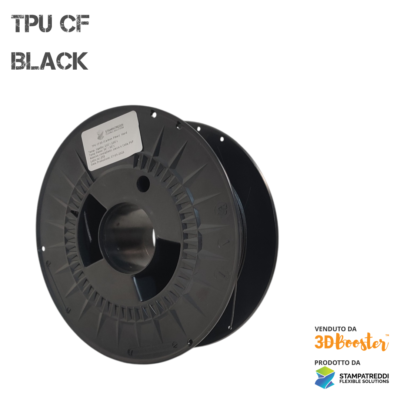
TPU CF Filament for 3D Printing: Carbon Fibre Reinforced at 20%
Black Color
Recommended printing parameters
- Material Drying: 4 hours at 80 °C
- Nozzle temperature: 210-230 °C
- Print bed temperature: 50-60 °C
- Chamber Cooling: OFF
- Ugello consigliato: Steel
TPU CF is a technical filament based on thermoplastic polyurethane reinforced with carbon fibre, developed for applications requiring controlled flexibility, mechanical strength and good stability in demanding environments.
Before printing, drying the material at 80 °Cis recommended. To achieve consistent results, especially on functional parts, it is important to print the filament dry and store it away from moisture.
The recommended printing temperature is between 210 and 230 °C. A heated chamber is not necessary and can be left off. The use of a steel nozzle, since the presence of carbon fibre makes the material abrasive for standard brass nozzles.
TPU CF: flexible, technical, tough
TPU CF combines the elastic nature of TPU with the greater rigidity and dimensional stability provided by carbon fibre reinforcement. The result is a material suitable for 3D printing technical components that are tough and slightly flexible, designed to work in more severe conditions than a traditional TPU.
The hardness of the material is high for a TPU: 91 Shore A and 70 Shore D. This makes it more rigid and less rubbery, while still maintaining a good ability to absorb impacts and vibrations. The Charpy notched impact strength is 45 kJ/m², while the elongation at break is 15%. The tensile strength at break is 60 MPa.
It is a very interesting choice for the automotive and motorsport, where it can be used for brackets, supports, guards, anti-vibration components, cable glands, spacers, conveyors, parts subject to dynamic stresses and small functional elements to be used in the vicinity of oils, fuels, vapours and hydrocarbons.
The material in fact offers excellent resistance in environments where hydrocarbons, technical vapours, oils and contaminants typical of workshops, production departments, vehicles, motorcycles, karts, prototypes and industrial equipment are present. It is also suitable for components that must withstand vibrations, repeated impacts, light rubbing and non-ideal operating conditions.
Recommended applications
TPU CF is suitable for:
- functional components for automotive and motorsport
- technical supports and brackets
- impact protection
- anti-vibration elements
- cable glands, bushings, spacers and inserts
- parts for tools, equipment and jigs
- components for technical prototypes
- parts exposed to oils, vapours, fuels and hydrocarbons
- applications where a standard TPU is too soft
- parts requiring mechanical strength, flexibility and stability
Thanks to the carbon fibre, the material maintains a clean, technical finish with a matte, professional appearance. It is a good solution for those looking for a flexible but more rigid filament, more stable and more suitable for real components, not just aesthetic ones.
Main technical characteristics
Density: 1.24 g/cm³
Hardness: 91 Shore A / 70 Shore D
Charpy notched impact strength: 45 kJ/m²
Allungamento a rottura: 15%
Tensile stress at break: 60 MPa
Vicat softening point: 91 °C
HDT at 0.45 MPa: 134 °C
HDT at 1.81 MPa: 70 °C
Surface electrical resistivity, dry: 4E5 ohm
Instructions for use
The material is not suitable for contact with food, for the transport of drinking water or for the production of children's toys. It is not indicated for applications in the pharmaceutical, medical or dental sectors.
PFAS-free product.
Reviews
There are no reviews yet.