
Summary for those who need to choose straight away
If you are looking for the most suitable material for your professional application, here is a quick comparison of the 5 filled polyamides analysed, based on technical data obtained from injection-moulded test specimens:
| Materiale | Key Strength | Ideal for… |
|---|---|---|
| PA12 CF | Maximum stiffness and toughness | Structures subjected to high static and dynamic loads |
| PA12 GF | Good stiffness/flexibility balance | General mechanical components requiring robustness |
| PA12 KF | Self-lubricating, extremely elastic and impact-resistant | Sliding parts, hooks, clips, flexible systems |
| PA12 CKF | Self-lubricating and good stiffness/flexibility balance | Mixed applications requiring smoothness and strength |
| SP4CF15 | High heat resistance and stiffness. It prints in open chamber. | Complex technical parts 3D printed even with desktop printers |
Try the KIT BUNDLE PA12 fibre reinforced.
👉 Subscribe to our newsletter to receive technical updates, video tutorials and new materials in preview.
Introduction: Filled Polyamides and Industrial 3D Printing
Polyamides (nylon) are high-performance technical materials used in many sectors for their excellent mechanical strength, chemical stability and good processability. In particular, PA12 stands out for its low hygroscopicity and high dimensional stability.
From an additive perspective, fibre-reinforced polyamides (carbon, glass, aramid/kevlar) offer improved performance, making them perfect for the production of structural, functional components or those subject to harsh environments. In this article we analyse five materials based on laboratory data obtained on injection-moulded specimens, a method that guarantees stable and comparable results.
Five parameters
The parameters chosen for this comparison were selected to provide a reliable technical picture oriented towards the practical use of materials in industrial or professional contexts. Each of them represents a fundamental characteristic of the mechanical and thermal behaviour of reinforced polyamides:
- Impact resistance (Charpy): allows assessment of the material's behaviour under discontinuous mechanical stresses, vibrations, accidental impacts or impulsive movements. It is a critical data point for components subject to impacts or installed in dynamic environments.
- Elongation at break: measures the percentage deformation a material can withstand before breaking. It is an indicator of ductility, and is very useful for evaluating use in safety elements, limit switches or flexible supports, where impact absorption without breakage is essential.
- Elastic modulus: indicates the toughness and stiffness of a material, i.e. its ability to resist elastic deformation under load. It is a fundamental parameter in the design of structural components, gears, rigid supports or mechanical joints.
- HDT (Heat Deflection Temperature): represents the temperature at which the material begins to deform under load. It is indispensable in environments where high temperatures or constant thermal cycles are present, such as in the automotive, electronics or mechanical sectors.
- Density: although the variations between the polyamides considered are limited, specific weight becomes a relevant parameter when the design requires lightness, as in robotic, aeronautical or motorsport applications.
👉 Thanks to this data, in relation to the intended use of the final part, the user can precisely select the most suitable material, optimising performance, durability and workability.
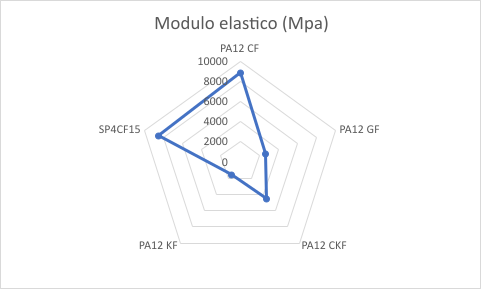
1. Toughness – Elastic Modulus
The elastic modulus (MPa) measures the stiffness of the material, i.e. its resistance to elastic deformation under stress. It is essential for load-bearing structures and parts that must maintain shape and precision under load.
Test method: ISO 527-1 tensile test.
Classification – from stiffest to most flexible:
- PA12 CF – 8900 MPa
- SP4CF15 – 8500 MPa
- PA12 CKF – 4500 MPa
- PA12 GF – 2700 MPa
- PA12 KF – 1500 MPa
➡️ PA12 CF is the choice for those seeking maximum structural rigidity. SP4CF15, although not PA12, has comparable performance and is easier to print.
2. Tensile Strength – Elongation at Break
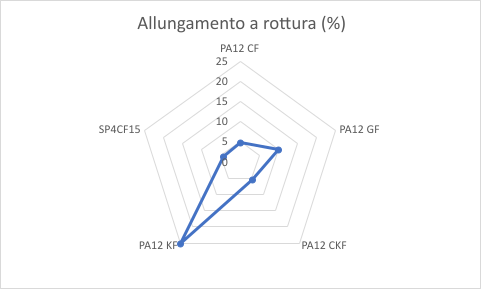
Theelongation at break (%) represents the material's ability to deform before breaking. It is indicative of ductility, useful for parts subject to repeated bending or dynamic loads.
Test method: ISO 527-1 tensile test.
Ranking – from most ductile to least ductile:
- PA12 KF – 25%
- PA12 GF – 10%
- PA12 CKF – 5,4%
- PA12 CF – 4,9%
- SP4CF15 – 4,2%
➡️ PA12 KF, thanks to the aramid fibre (Kevlar®), is the most elastic material: perfect for flexible, sliding or repeated-impact elements.
3. Impact Resistance – Charpy Test
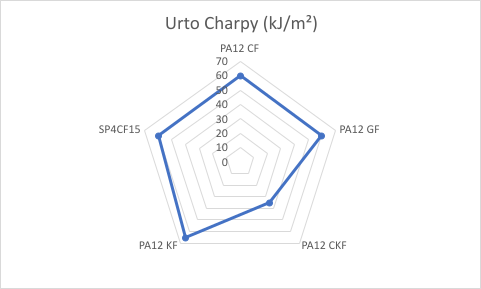
The Charpy test measures the amount of energy absorbed by a specimen until breakage, indicating impact resistance.
Test method: Charpy with unnotched specimen ISO 179-1eU.
Ranking – from most resistant to least resistant:
- PA12 KF – 65 kJ/m²
- PA12 CF / GF / SP4CF15 – 60 kJ/m²
- PA12 CKF – 35 kJ/m²
➡️ Once again, the aramid fibre (Kevlar®) proves to be a winner for components exposed to frequent impacts or vibrations.
4. Thermal Resistance – HDT at 0.45 MPa
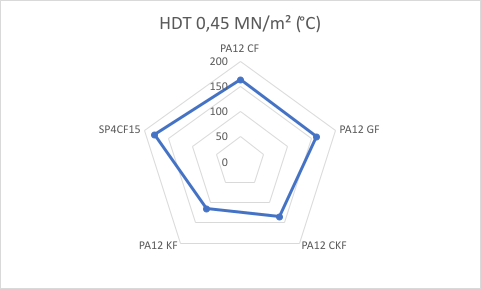
The Heat Deflection Temperature (HDT) is the temperature at which a material begins to deform under a continuous load. It is critical for industrial, automotive and electrical applications.
Test method: ISO 75, load 0.45 MPa.
Ranking – from most resistant to least resistant:
- SP4CF15 – 179 °C
- PA12 CF – 163 °C
- PA12 GF – 161 °C
- PA12 CKF – 135 °C
- PA12 KF – 115 °C
➡️ The SP4CF15 is the only material that combines high thermal resistance and desktop printability, representing an excellent solution for functional prototypes and industrial pre-series.
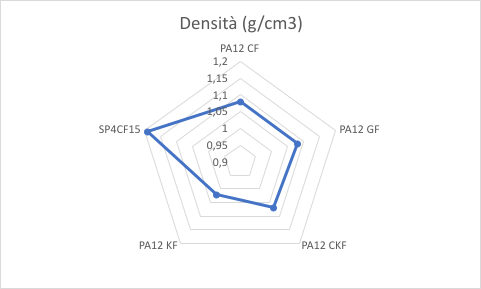
5. Density – Impact on weight and design
The density indicates the mass of the material per unit of volume (g/cm³) and is decisive in contexts where weight must be reduced, such as in aerospace, racing or robotics.
Test method: gravimetric measurement on a standardised sample.
Ranking – from lightest to heaviest:
- PA12 KF – 1.02 g/cm³
- PA12 CKF – 1.07 g/cm³
- PA12 CF / GF – 1.08 g/cm³
- SP4CF15 – 1.19 g/cm³
➡️ The PA12 KF is the ideal choice when weight is a critical factor.
When to Use Which Material
✔️ PA12 CF (Carbon)
- ✅ Maximum rigidity
- ✅ High heat resistance
- ❌ Low elasticity
Ideal for: rigid frames, structural parts, precision mechanical components.
✔️ PA12 GF (Glass fibre)
- ✅ Acceptable rigidity
- ✅ Better elongation than CF
Ideal for: general components, housings, sturdy supports.
✔️ PA12 KF (Kevlar®)
- ✅ Extreme elasticity and impact resistance
- ✅ Self-lubricating properties
Ideal for: moving parts, gears, slide guides.
✔️ PA12 CKF (Carbon + Aramid/Kevlar)
- ✅ Balance between stiffness and dynamic strength
- ❌ Sensitive to impacts
Ideal for: intermediate technical applications, levers, joints.
✔️ SP4CF15 (Medium carbon, PA blend)
- ✅ Printable with consumer printers
- ✅ Extremely high stiffness and thermal resistance
Ideal for: advanced technical prototypes, functional series, critical environments.
Conclusion
Choosing the right material directly affects the functionality, durability and reliability of the final component. Based on the data analysed, each filled polyamide finds its perfect place in industrial, mechanical, electronic or sports applications.
A particularly relevant point is represented by the material SP4CF15: although it is not a PA12, it offers thermal and mechanical properties practically overlapping those of PA12 CF, but with a huge advantage: it is extremely easy to print even on desktop 3D printers, with the same simplicity as a technical PLA.
This characteristic makes it a extraordinary solution for companies, designers or advanced makers who want to create functional prototypes or final parts independently, without investment in complex professional equipment.
🔧 Do you have doubts about the most suitable material for your application? Contact us or subscribe to our newsletter to receive dedicated technical support.